
As an Amazon Associate I earn from qualifying purchases.
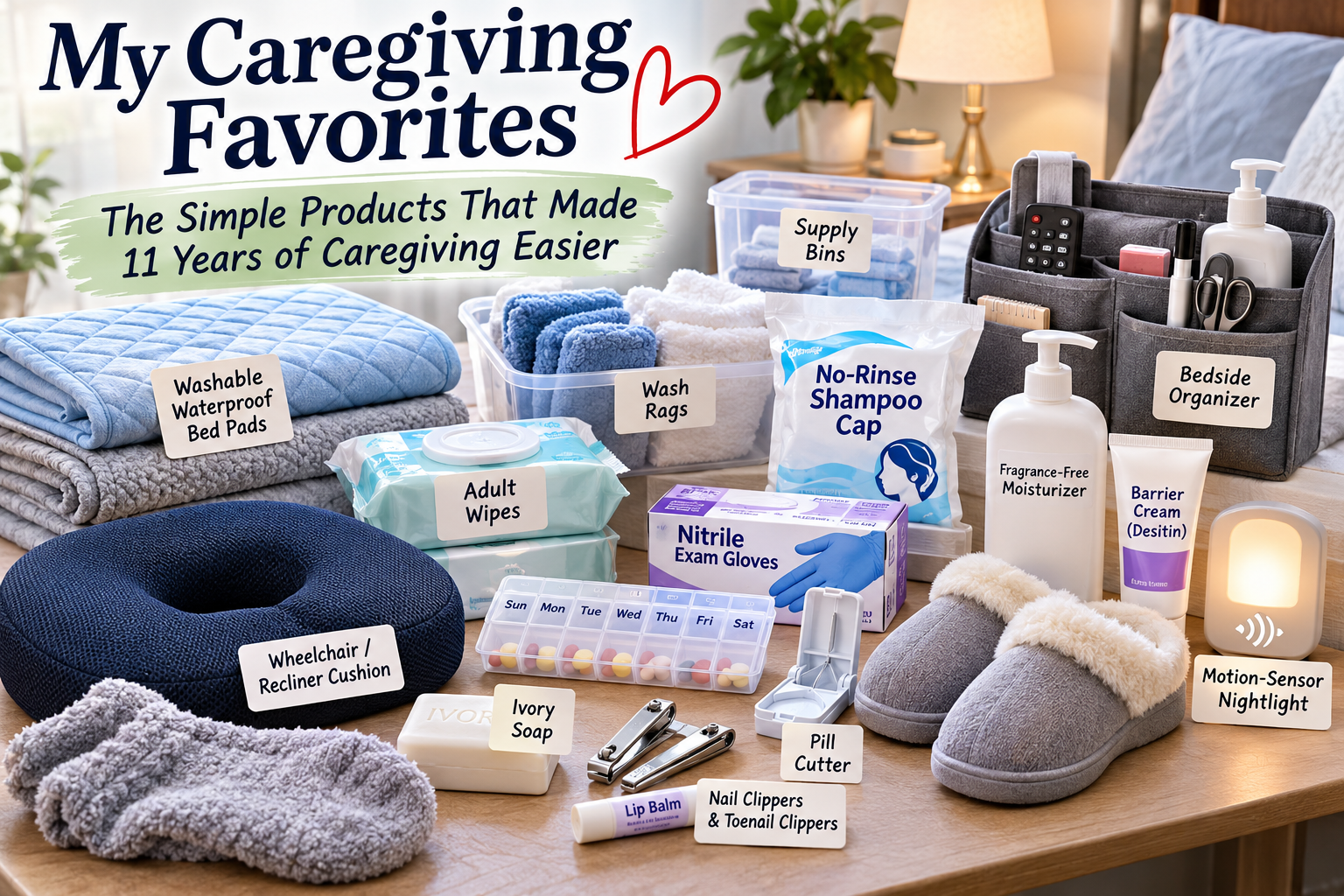
After 11 years of caring for my grandmother, these are the everyday products I relied on, the little things that made a difference, and a few additional products worth considering.
After 11 years of caregiving, I learned that some of the most useful products aren’t expensive, fancy, or even marketed specifically to caregivers.
Sometimes it’s a washable waterproof bed pad. Sometimes it’s a shampoo cap that saves you from turning hair-washing day into a major production. And sometimes it’s having a clean washcloth within reach instead of realizing you left everything in the other room.
When you’re caring for someone who depends on you for nearly everything, those little conveniences start to matter. A lot.
During my grandmother’s later years, after two strokes, she had very limited mobility and eventually became completely bedbound. She depended on me for virtually every aspect of her daily care.
I learned pretty quickly that having the right supplies didn’t make caregiving easy, but it certainly made some of the harder parts more manageable.
These are my personal caregiving favorites. Not because they’re trendy or expensive, but because they helped me get through everyday care.
And no, you don’t need to buy everything on this list. Start with what actually makes sense for your situation.
The Everyday Products I Actually Used
1. Washable Waterproof Bed Pads
If I had to pick one caregiving product I wouldn’t want to do without, washable waterproof bed pads would be right near the top.
When you’re caring for someone who is incontinent or bedbound, accidents happen. Sometimes more than once a night.
Washable bed pads helped protect the bedding and made cleanup easier without having to strip the entire bed every single time.
And when you’re already doing what feels like seventeen loads of laundry a day, anything that saves you from washing another set of sheets deserves some recognition.
What I recommend: Keep several washable pads on hand so there’s always a clean one ready. Look for absorbent pads with waterproof backing that can handle repeated washing.
My caregiving tip: Don’t wait until you’re down to your last clean pad to do laundry. That’s usually when everything goes wrong.
Amazon product link: Washable Waterproof Bed Pads
2. Adult Wipes, Ivory Soap, and Good Old-Fashioned Washcloths
I didn’t need an entire cabinet full of expensive bathing products.
Some of my most-used personal care supplies were adult wipes, Ivory soap, and simple washcloths.
Adult wipes were convenient for quick cleanups and incontinence care. Soap and washcloths were part of our regular bathing routine.
Nothing fancy. Just everyday products that worked for us.
For sensitive skin, I recommend choosing gentle, fragrance-free products and avoiding unnecessary scrubbing. A soap that worked for my grandmother won’t necessarily work for everyone, especially when skin is fragile.
And washcloths? Buy plenty.
You will use more than you think.
My caregiving tip: Keep clean washcloths separate from used ones and use fresh cloths for different areas of the body.
Amazon product links: Adult Wipes | Soft Washcloths
3. No-Rinse Shampoo Caps
Now this is one product I really appreciated.
When someone is bedbound, washing their hair isn’t always as simple as leaning them over a sink or helping them into the shower.
Sometimes it becomes an entire production.
No-rinse shampoo caps helped make hair washing much more manageable without requiring a trip to the bathroom.
They aren’t necessarily a replacement for every traditional hair wash, but they can be a wonderful alternative when mobility is limited.
What I recommend: Look for shampoo caps that are easy to use, gentle on the scalp, and don’t require additional rinsing. Follow the manufacturer’s instructions, especially if warming them.
My caregiving tip: Have a towel ready and take your time. Even something as simple as clean hair can help someone feel more comfortable and refreshed.
Amazon product link: No-Rinse Shampoo Caps
4. A Supportive Wheelchair Cushion
When someone spends a significant amount of time sitting, comfort and pressure management become especially important.
A supportive wheelchair cushion, particularly one designed to redistribute pressure around the tailbone and sitting bones, is worth paying attention to.
The right cushion can help with positioning and comfort, but not every cushion is appropriate for every person.
For someone at risk of pressure injuries, a properly fitted pressure-redistributing cushion should be selected with guidance from a healthcare professional.
What I recommend: Look beyond how soft a cushion feels. Consider pressure redistribution, fit, posture, and the person’s individual needs.
Amazon product link: Wheelchair Pressure-Relief Cushion
5. Bedside Organizers
Here’s something caregiving taught me:
Organization isn’t about making everything look pretty.
It’s about not having to search through three drawers while someone is waiting for you.
A bedside organizer helped keep frequently used supplies within reach.
Wipes, gloves, washcloths, lip balm, lotion, and other everyday essentials all needed a place.
Because at two in the morning, the last thing you want is a scavenger hunt.
What I recommend: Choose an organizer with compartments that are easy to access and clean. Keep the most frequently used items closest to where care happens, while storing medications and other potentially hazardous items securely.
Amazon product link: Bedside Supply Organizer
6. Storage Bins for Caregiving Supplies
Along with a bedside organizer, I found storage bins incredibly helpful.
When you’re managing gloves, wipes, personal care products, bedding supplies, and everything else, things can get out of control quickly.
I liked having designated places for different categories of supplies.
One bin for hygiene products. Another for extra gloves and wipes. Another for backup supplies.
It doesn’t have to look like a professionally organized pantry.
It just has to make sense to you.
My caregiving tip: Clear bins or labeled containers make it easier to see what you’re running low on before you completely run out.
Amazon product link: Stackable Storage Bins
7. Pill Organizers and Pill Cutters
Medication routines can become complicated, especially when someone takes several medications throughout the day.
A pill organizer can help keep an appropriate medication schedule organized and reduce some of the mental load.
A pill cutter can also be useful when a medication needs to be split.
But here’s something important: not every medication can safely be cut, crushed, or stored outside its original packaging. Always check with a pharmacist before splitting pills or transferring them into an organizer.
My caregiving tip: Keep an updated medication list with the medication name, dose, schedule, and any special instructions.
It’s one less thing to rely on memory for.
Amazon product links: Weekly Pill Organizer | Pill Cutter
8. Warm Socks and Easy Slip-On Slippers
Sometimes comfort comes down to something as simple as warm feet.
Soft socks and easy-to-use slippers were among those little everyday items I appreciated.
When someone has limited mobility, even getting dressed can require extra effort.
I preferred simple, comfortable options that didn’t turn putting something on into another complicated task.
What I recommend: Choose soft socks without tight bands. For someone who stands, transfers, or walks, slippers should fit securely and have non-slip soles.
Loose, slippery footwear can create a fall risk.
Amazon product links: Soft Socks | Non-Slip Slippers
9. Nail Clippers and Toenail Care Supplies
Here’s something people don’t talk about enough: nail care.
Keeping fingernails and toenails maintained is part of everyday hygiene, but it can become difficult when someone has limited mobility.
Regular nail clippers were useful for basic care.
Thick toenails, however, can be another story entirely.
For very thick nails, poor circulation, diabetes, or other foot problems, professional nail care may be safer than trying to force a heavy-duty clipper through them.
My caregiving tip: Don’t overlook hands and feet during routine care. Small problems can become much bigger when someone can’t easily tell you something is bothering them.
Amazon product link: Easy-Grip Nail Clippers
10. Lip Balm and Fragrance-Free Skin Moisturizers
Dry lips and uncomfortable skin might seem minor compared with everything else happening during caregiving.
But those little discomforts add up.
I liked keeping lip balm and gentle, unscented moisturizers nearby.
You don’t need an expensive skincare collection.
A few dependable products that agree with the person’s skin can go a long way.
What I recommend: Look for fragrance-free moisturizers designed for sensitive skin. Apply according to the person’s skin-care needs and avoid products that cause irritation.
Amazon product links: Lip Balm | Fragrance-Free Moisturizer
11. Desitin and Skin Barrier Creams
Desitin was definitely one of the products I kept on hand.
When you’re caring for someone with incontinence, protecting skin from prolonged moisture exposure is important.
Zinc oxide barrier creams can help protect intact skin from irritation caused by moisture.
But there’s an important difference between moisture-related irritation and pressure injuries.
Barrier creams do not treat pressure sores or open wounds. Pressure injuries require appropriate assessment, pressure relief, and an individualized treatment plan.
My caregiving tip: Pay attention to persistent redness, skin breakdown, or changes in skin color or texture. Don’t assume every skin problem is simply diaper rash.
Amazon product link: Desitin Zinc Oxide Barrier Cream
12. Medical-Grade Disposable Gloves
I went through plenty of disposable gloves.
Between incontinence care, bathing, cleaning, and other personal care tasks, gloves were an everyday necessity.
And I learned that keeping gloves in more than one location was much more convenient than constantly walking back and forth to grab another pair.
What I recommend: Choose appropriately sized medical examination gloves suitable for the tasks you’re performing. Nitrile gloves are a common latex-free option.
Gloves should be changed between tasks, and hand hygiene is still necessary before and after using them.
Amazon product link: Disposable Nitrile Examination Gloves
13. Extra Washcloths
Yes, washcloths are getting another mention.
Because I really did use that many.
Sometimes the most useful caregiving supplies are the least exciting things in the house.
Soft, washable cloths are useful for bathing, personal care, and everyday cleanup.
And having plenty available means you’re not constantly trying to keep up with laundry just to have something clean for the next task.
My caregiving tip: Keep a separate supply of washcloths specifically for personal care, and replace them when they become rough or worn.
Amazon product link: Soft Cotton Washcloths
The Organizational Tool I Wish Every Caregiver Used
14. A Caregiving Supply Inventory List
This one isn’t something you necessarily need to buy from Amazon.
But it might save you more frustration than another fancy gadget.
Running out of wipes, gloves, bed pads, or personal care supplies at the worst possible moment is something I wouldn’t wish on anyone.
And when you’re already remembering medications, appointments, meals, and everything else, keeping a mental inventory of supplies is just one more responsibility.
A simple supply tracker helps you see what you have, what you’re running low on, and what needs to be reordered.
That’s why I created a Supply Tracker as part of my Bedbound Care Organizer Bundle through The Piney Chemist.
It’s designed to help caregivers keep track of everyday essentials without having to remember everything themselves.
Because your brain is already doing enough.
Find My Bedbound Care Organizer Bundle on Etsy
A Few More Products Worth Considering
These aren’t all products I personally relied on, but they’re worth considering depending on your caregiving situation.
15. Motion-Sensor Nightlights
Nighttime caregiving is exhausting enough without stumbling around in the dark.
A motion-sensor nightlight can make it easier to move around the bedroom, hallway, or bathroom without searching for a light switch.
I especially like the idea of lighting that turns on automatically when someone gets up.
Look for something bright enough to illuminate the path without being unnecessarily harsh.
For someone who gets up frequently during the night, good lighting is a simple home-safety improvement.
Amazon product link: Motion-Sensor Nightlight
16. Positioning Pillows and Wedges
I never relied on fancy positioning wedges when caring for my grandmother.
I used regular pillows.
They were familiar, easy to adjust, and useful for comfort and support.
But specialized positioning wedges may be beneficial in certain situations.
For someone who is bedbound or unable to reposition independently, positioning should follow guidance from their healthcare team. Neither ordinary pillows nor wedges replace appropriate pressure-relieving equipment or a recommended repositioning plan.
Amazon product link: Positioning Support Wedges
What I Learned About Buying Caregiving Products
One thing I learned over the years is that you can spend a lot of money on caregiving supplies that look helpful but don’t actually make your day any easier.
My advice?
Don’t buy something simply because it’s labeled a caregiver must-have.
Ask yourself whether it solves a problem you’re dealing with right now.
Does it save time? Make personal care easier? Improve comfort? Help you stay organized? Reduce unnecessary trips back and forth?
If it doesn’t serve a real purpose, it may just become one more thing you have to store, clean, or keep track of.
And caregivers already have enough to manage.
My Biggest Takeaway After 11 Years of Caregiving
Looking back, I don’t remember the fanciest products.
I remember the washable bed pads that saved me from another complete bedding change.
The shampoo caps that made hair washing less complicated.
The clean washcloths, the gloves, the bedside supplies, and the little things that helped keep my grandmother comfortable.
None of those products made caregiving easy.
They didn’t eliminate the exhaustion, the interrupted nights, or the emotional weight of being responsible for someone who depended on me.
But they made individual tasks easier.
And when you’re doing those tasks day after day, sometimes that makes a bigger difference than people realize.
My advice to other caregivers is simple: Don’t underestimate the little things.
You don’t need a house full of expensive equipment to make everyday care more manageable.
Sometimes you just need the right supplies, a little organization, and enough clean washcloths to survive another day.
And maybe a few less loads of laundry.
More Practical Help for Family Caregivers
If you’re caring for someone with limited mobility or feeling overwhelmed by everyday responsibilities, I have more resources available through The Piney Chemist.
Caregiver Burnout Survival Guide
A short, practical ebook filled with realistic strategies for managing caregiver exhaustion, reducing mental overload, and making everyday care more manageable.
Explore My Caregiver Burnout Survival Guide on Amazon
Caregiver Printables on Etsy
Keeping track of medications, supplies, appointments, and everyday care can feel like a full-time job on top of the full-time job you’re already doing.
That’s why I created practical caregiver printables to help you stay organized, prepare for unexpected situations, and take a little of the mental load off your shoulders.
No complicated systems. Just useful tools designed around real caregiving challenges.
Shop My Caregiver Printables on Etsy
Let’s Connect on Facebook
Caregiving can be exhausting, frustrating, and sometimes downright ridiculous.
Follow The Piney Chemist on Facebook for honest conversations, practical caregiving tips, a little humor, and the occasional reminder that you’re not the only one dealing with the chaos.
Follow The Piney Chemist on Facebook
And if you’re in the middle of caregiving right now, remember this:
You don’t have to make every part of caregiving easier all at once.
Start with one thing that’s making your day harder than it needs to be.
Sometimes that’s enough for today.
Amazon and the Amazon logo are trademarks of Amazon.com, Inc, or its affiliates.



Leave a Reply